
Gopher Tortoise Recipient Sites: How Longleaf Pine Restoration Generates Conservation Credit Income
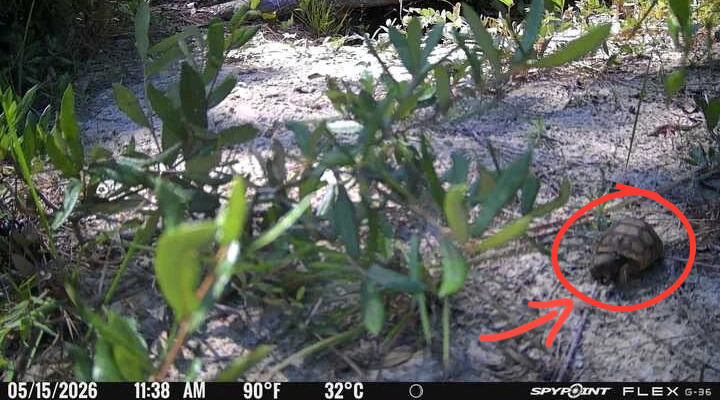
Baby gopher tortoise caught on camera at recently restored sandhil community.
By Edwin Stanford, PE and Jonathan Napier, Co-Founders, Land Equity Partners
A baby gopher tortoise recently appeared on one of our camera traps at a restored longleaf pine sandhill. That image confirms two things for us. The habitat has recovered, and the gopher tortoise recipient site on that land is producing conservation credit income.
A hatchling can only survive when several conditions hold at once. The sandy soils have to support burrows, wiregrass has to return, sunlight has to reach the ground, and fire has to be back in the understory. When all of those line up, the land gives us a signal no report can.
Why Is the Longleaf Pine Sandhill Worth Restoring?
The longleaf pine sandhill ranks among the most biodiverse ecosystems in North America. It has also been one of the most impacted. Early losses came from harvest for lumber during America's founding era, and later losses came from replanting with other species or from a lack of management.
Before European settlement, longleaf pine covered roughly 90 million acres across the Southeast. Less than three percent of that original range remains intact. That loss created both a conscious and a regulatory demand for restoration. In the markets where we operate, that demand has no ceiling.
What Happens When Fire Leaves the Landscape?
Longleaf pine depends on fire. Regular low-intensity burns keep the understory open, sustain the wiregrass, and preserve the canopy structure that defines the habitat.
The gopher tortoise is the keystone species of this system. It needs open ground to move, dig burrows, and forage. When the canopy or understory grows dense, those conditions disappear, and the tortoise loses the habitat it depends on.
Restoration means reintroducing fire, managing the understory, and rebuilding the habitat's structure. The work is active, technical, and ongoing. It also produces a category of conservation credit income that a wetland mitigation bank does not.
How Does a Gopher Tortoise Recipient Site Generate Income?
Wetland mitigation banking runs on a federal framework. Under the Clean Water Act, impacts to protected wetlands and streams require compensatory mitigation. Buyers purchase credits from mitigation banks to satisfy their permit conditions. We cover that model in our breakdown of [the dual income land investment model](LINK TO ISSUE 1 BLOG POST).
Gopher tortoise recipient sites run on a parallel track that is regulated at the state level. In Florida and a few other southeastern states, any developer whose project disturbs land occupied by gopher tortoises must relocate those tortoises to an authorized recipient site. A permitted recipient site is a property that meets the ecological standards needed to receive and sustain the relocated animals.
In Florida, the site's sponsor or operator receives a payment for each tortoise brought onto the property. That payment is conservation credit income. The site can keep generating it until it reaches carrying capacity.
Why Does Recipient Site Demand Hold Up When Markets Shift?
Relocation demand comes from more than private development. Public sector transportation, defense, park, and education projects create it too. As a result, this income stream runs on a timeline independent of interest rates and of whatever the Federal Reserve decides next.
This is one reason conservation credit income sits alongside development returns in our model. One property can carry two revenue engines, and neither one depends on the other.
What Do We Look For When We Walk a Property?
We evaluate every acquisition through three lenses: Market, Makeup, and Policy. Market and Policy are analytical. Makeup can only be read on the ground.
On a site walk, we read three things at the same time:
The land's current ecological condition and how degraded it is
The historical community type the land once supported, and whether it can be restored
What the regulatory environment in that service area values, and which ecology will be compensated
The answer to each one shapes the other two, so we assess them together.
A longleaf pine sandhill kept from fire for decades and overrun with hardwoods looks like scrubby, unproductive land to most people. We see a restoration candidate. The soils are still sandy, the seed bank likely still holds wiregrass, and a stressed tortoise population may still be present. The distance between what land looks like and what it can become is where conservation and the investment thesis meet.
We have also seen land donated to conservation organizations that stays protected on paper. Without an active management plan, however, the habitat on that land continues to decline.
What Disqualifies a Property Fast?
Three things usually rule a property out early:
Hydrology altered beyond cost-effective restoration, for wetland sites
A service area with no active buyer demand for the credit type the land could support
A land use history that destroyed the seed bank or compacted the soil beyond practical recovery
Within one site visit, we know whether the land's story allows the math and the science to work.
Why Does Permitting Experience Matter in Conservation Investment?
Permitting a mitigation bank or a conservation bank (recipient site) is among the most technically demanding pathways in the regulatory world. The Army Corps of Engineers reviews the site's hydrology, restoration plan, credit methodology, and long-term management structure, along with multiple state and federal commenting agencies. Financial assurance documents and conservation easements must be in place before a single credit can be released for sale. Most projects that attempt this process do not succeed.
Jonathan Napier, our Co-Founder and President, has been directly involved in permitting over a dozen wetland and conservation mitigation banks. Over more than 30 years, he has also managed the relocation of hundreds of gopher tortoises. That record includes many site evaluations where the answer was no, before anyone spent capital or time. Meet our founders.
Our conservation work is credible because of that proven ability to permit land, restore it, and generate income from it.
What Did the Camera Trap Confirm?
The tortoise that laid the egg for the hatchling in our photo chose that sandhill for a reason. The soils are right, food sources have returned, and the habitat has recovered enough to support reproduction. Each of those factors also drives the credit income model behind the site.
Years in the consulting field taught us that land's ecological value and its financial value are the same value, accessed from different sides. The tortoise on the camera trap is the ecological confirmation. The tortoises relocated onto the site are the financial confirmation.
What Is Conscious Stewardship?
Conscious stewardship is the foundation of our business model. We define it as "the intentional management of land, resources, wealth, and influence according to one's moral principles, with a commitment to leaving people, communities, and the natural world better than they were found."
The intent of conscious stewardship is to purposefully align development with conservation and reconnect people with land. On the right ground, with the right team, conscious stewardship and above market returns work toward the same outcome.
Investors can learn more on our For Investors page. Landowners can see how we evaluate property on our For Landowners page.
Curious what your land could produce? No pressure. No pitch. Just a real conversation about whether there is a fit.
Frequently Asked Questions
What is a gopher tortoise recipient site?
A gopher tortoise recipient site is a permitted property that meets the ecological standards needed to receive and sustain gopher tortoises. The tortoises are relocated from development sites that disturb occupied land.
How does a gopher tortoise recipient site generate income?
In Florida, the recipient site's sponsor or operator receives a payment for each tortoise brought onto the property. That conservation credit income continues until the site reaches carrying capacity.
Which states require gopher tortoise relocation?
Florida and a few other southeastern states require developers to relocate gopher tortoises from disturbed land to an authorized recipient site.
Why does longleaf pine restoration require fire?
Longleaf pine is a fire-dependent ecosystem. Regular low-intensity burns keep the understory open and sustain wiregrass, and the gopher tortoise needs those conditions to burrow and forage.
Is conservation credit income tied to the housing market?
Recipient site demand comes from private development and from public transportation, defense, park, and education projects. That demand runs on a timeline independent of interest rates.
How is a recipient site different from a wetland mitigation bank?
Wetland mitigation banks operate under the federal Clean Water Act. Gopher tortoise recipient sites operate under a parallel framework regulated at the state level.